Current paytable · Under optimal fair-deck play · 600M simulated hands
Provably Fair Engineering TeamResearch and analysis
VIDEO POKER
9HOLD
2
9HOLD
8
6
Advertised house edge2%Published edge
Calculated house edge≈3.6%600M-hand simulation
A shuffle bias documented in BC.GAME’s verifier since April 2020 raises the current house edge from 2% to about 3.6%, under optimal fair-deck play. If you’ve played its Video Poker since then, you may be affected.
2% is advertised. Under optimal fair-deck play, BC’s deal on the current paytable has a calculated house edge of about 3.6%. That means about $16 extra expected loss per $1,000 wagered, and a house edge roughly 1.8× as large.
02 / WHY CHECKS MISS ITBiased deal
Verification passes. The shuffle is biased.
All 62 live hands match BC’s verifier, including the initial and replacement cards. Reproducing a deal proves it follows the seeds; it does not prove the cards were shuffled fairly.
How Video Poker works and what went wrong
You receive five cards, choose which to hold, and replace the rest. A fair shuffle makes every five-card starting hand equally likely. BC instead sorts 52 shifted copies of one hash. Cards that sit next to each other in its fixed list tend to arrive together, and valuable combinations become less common.
With optimal fair-deck strategy, matching BC’s hints on all 62 tested hands, the current game returns about 96.4% against 98% advertised. The published verifier has used this card list since April 2020. Dated sources link the historical paytables to the method; they do not establish every live round or the exact rollout date.
The verdict
Review area
What the evidence shows
Finding
House edge
About 3.6% under optimal fair-deck play on the current paytable, against 2% advertised.
Above advertised
Evidence
Initial cards and replacements match BC’s verifier; payouts match the server paytable.
62 / 62 matched
Provably Fair
Seed replay reproduces the cards. It does not establish fair odds.
Results verify
Calculated house edge
≈3.6%
Under optimal fair-deck play
Extra expected loss
≈$16
Per $1,000 wagered
Current-table simulation
600M hands
RTP 95% interval: 96.37–96.44%
Current card list published
April 2020
Exact live rollout not established
How Video Poker worksThe deal, holds, replacements and how the paytable sets the return
You receive five cards, choose which to hold, and replace the rest from the next cards in the deck. Every five-card starting hand is equally likely under a fair shuffle. The current paytable then returns 98.02% with optimal play; BC’s deal returns 96.40% using that same strategy.
A REAL HAND FROM OUR SESSION · 16 NOVEMBER 2026
1. Choose which cards to keep
Hold the two tens. The other three cards will be replaced.
10HOLD
5
4
10HOLD
2
2. Draw three replacements
Take cards 6, 7 and 8 in order. Fill the empty positions from left to right.
CARD 6
10
→ Position 2
CARD 7
4
→ Position 3
CARD 8
10
→ Position 5
3. Pay the final hand
Four tens make four of a kind. The paytable returns 22× the bet, including the stake.
0.10 USDT → 2.20 USDT
10
10
4
10
10
Held cards stay in place. Discarded cards are not returned to the deck. Replace up to five cards; each replacement uses the next card in the sequence.
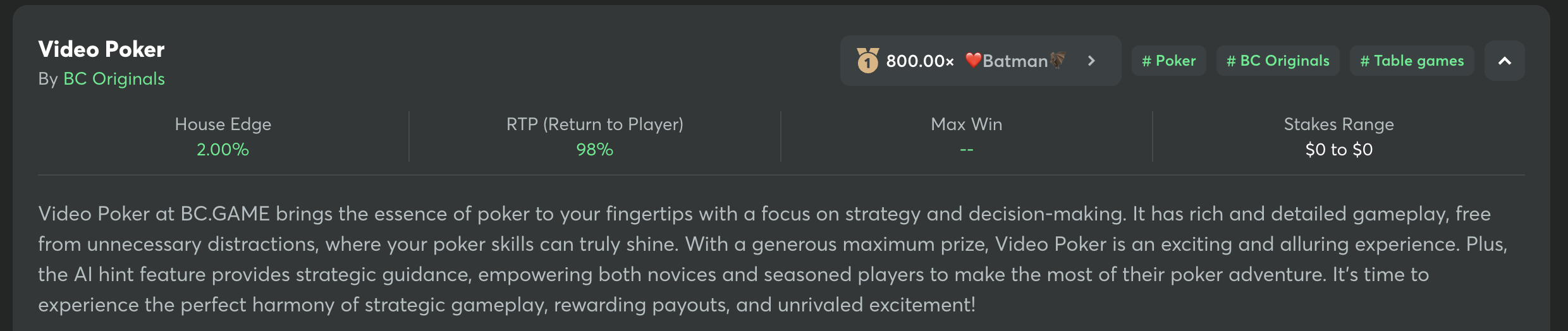
The game page says “RTP (Return to Player) is 98%.” Its information panel states a 2.00% house edge, and the game API labels VideoPoker98 with rtpDes: 98.
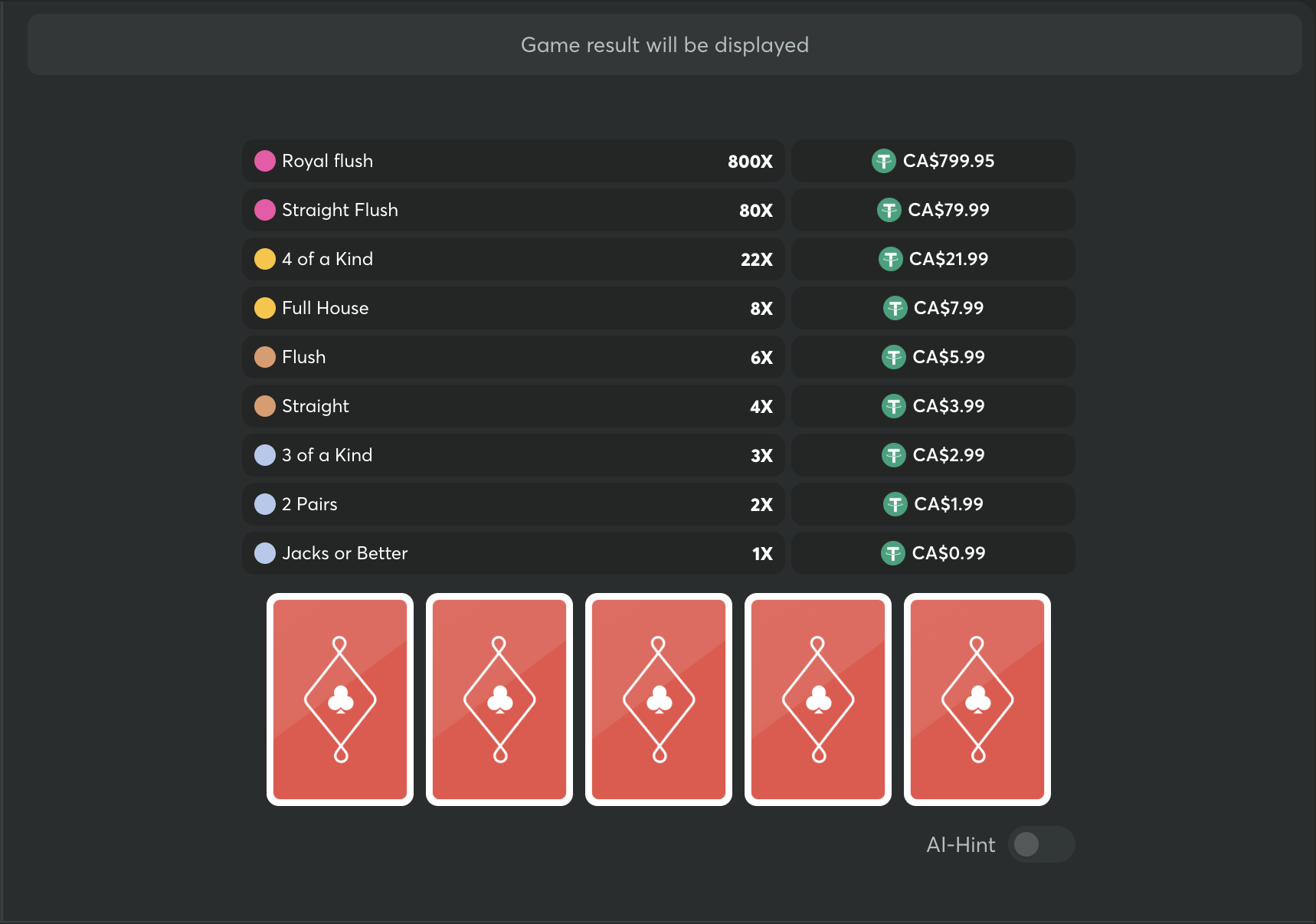
BC.GAME describes a single, fresh 52-card deck per round. The paytable below governed all 62 tested hands.
Published RTP
“RTP (Return to Player) is 98%.”
BC.GAME Video Poker · Screenshot captured 17 November 2026 House Edge: 2.00% · Advertised RTP: 98%
Scale enlarged to 94–100% so the difference is visible. The exact fair-shuffle benchmark for this paytable is 98.02%; historical comparisons are in the detail below.
Played an earlier version?
The 99%, 96% and current 98% tables all show a shortfall under optimal fair-deck play.
ADVERTISED VERSION
FAIR SHUFFLE
BC’S DEAL
BELOW ADVERTISED
98% · current
98.02%
96.40%
1.60 points
96% configuration
95.98%
94.46%
1.54 points
99% · historical
98.94%
97.29%
1.71 points
98% · current
Fair shuffle
98.02%
BC.GAME deal
96.40%
96% configuration
Fair shuffle
95.98%
BC.GAME deal
94.46%
99% · historical
Fair shuffle
98.94%
BC.GAME deal
97.29%
Fair-shuffle returns are exact. BC’s deal is simulated: 600M hands for 98%; 300M each for 96% and 99%. The 95% intervals are 96.37–96.44%, 94.41–94.51% and 97.24–97.34%, respectively.See the dated evidence and paytables ↓
Fair-deck calculations and simulation resultsExact fair-shuffle benchmarks, simulated results and historical limits
RETURN BY DOCUMENTED PAYTABLE
The paytable stays the same. The deal changes the return.
96.40%
BC’s deal · current 98% version
98.02%
Exact return with a fair shuffle
−1.62 pp
Difference against the fair deck
● BC’s deal ○ Fair shuffle Same optimal fair-deck strategy for each table
CURRENT · 98%
96.40%98.02%
99% VERSION
97.29%98.94%
96% VERSION
94.46%95.98%
94%95%96%97%98%99%100%
Current estimate: 600 million hands · 95% interval: 96.37–96.44% · Horizontal scale starts at 94%.The 96% paytable was retrieved in November 2026. Its earlier use is inferred from archived configuration; no live hand from that version was captured.
What “optimal strategy” meansThe strategy used in this report and what the 62 hint checks establish
The strategy compares every possible hold using a fair deck and the exact paytable. It chooses the hold with the highest average payout.
OPTIMAL FAIR-DECK STRATEGY
Five cards. Two choices for each.
Illustrative starting hand. The calculation considers all holds.
9Hold or replace
2Hold or replace
9Hold or replace
8Hold or replace
6Hold or replace
2 × 2 × 2 × 2 × 2 = 32 possible holds
01 / COMPARE
32 holds
Keep any combination: none, some or all five cards.
02 / CALCULATE
All fair draws
Enumerate every possible replacement hand from the remaining deck.
03 / CHOOSE
Best average
Select the hold with the highest average payout for this paytable.
2,598,960
Possible opening hands
Every five-card starting hand is evaluated.
62 / 62
Hints matched a best hold
BC’s hint was a best hold on every tested hand.
A best hold maximizes expected return; it does not guarantee a winning hand.
02
Why the shuffle is biased
Each card receives the same hash shifted by its position in a fixed list. The cards are sorted by these readings, and the first ten become the deal and replacement cards.
Neighbours read almost the same string, one character apart. Runs of low characters can give neighbouring cards low readings together. Across 600 million deals, list neighbours appeared anywhere in the same five-card hand 1.30 times as often as under a fair shuffle. This does not mean matching suits cannot appear together.
HOW THE VERIFIER BUILDS A DEAL
01
01 / One hash
Turn the seeds into one 128-character string.
128 characters
02
02 / Shift it
Start one character later for each next card.
One shared string
03
03 / Sort cards
Order all 52 cards by these linked keys.
Smallest key first
04
04 / Take ten
Five opening cards, then five replacement cards.
5 dealt + 5 draws
WORKED EXAMPLE · NOT A LIVE BET
One run of zeros pulls neighbouring cards forward.
01 / Three cards read neighbouring positions in the same hash
Card 33↓0
Card 34↓0
Card 35↓0
369
37d
389
390
Zoomed part of the hash. The cards above it are neighbours in BC.GAME’s fixed list.
02 / All three get low sorting keys
First four characters of each full sorting key:
5
LIST POSITION 330009
8
LIST POSITION 34009d
J
LIST POSITION 3509d9
03 / Those neighbours arrive in the same opening hand
51st
82nd
J3rd
94th
105th
The verifier sorts all 52 keys. In this example, the three outlined neighbours take places 1, 2 and 3.
≈30%more often
Across 600 million simulated deals, neighbours in the fixed list appeared in the same opening hand about 30% more often than with a fair shuffle. This example shows how that linkage happens.
The complete hash and all 128-character keys are in “Current verifier formula” below.
WORKED EXAMPLE · NOT A LIVE BET
One run of zeros links three cards.
1. Start at neighbouring characters
0009d90
Characters 33, 34 and 35 are all zero. Each card starts reading the same hash one place later.
2. Three cards get low sorting keys
50009List position 33
8009dList position 34
J09d9List position 35
First four characters shown. Every sorting key still contains the full 128-character hash.
3. All three enter the opening hand
58J910
Sorting all 52 keys places these three neighbours first, second and third in this example.
≈30% more oftenAcross 600 million simulated deals, neighbours in the fixed list appeared together in the opening hand about 1.30× as often as under a fair shuffle.Full keys and the reproducible example are in “Current verifier formula” below.
WHY THE STARTING ORDER MATTERS
The starting list decides which cards the bias favours.
Original list, 2019–April 2020
A2345
A2345
Neighbours share a suit and adjacent ranks, favouring suited and connected cards.
List published since April 2020
A47102
A47102
No neighbours share a suit or rank.
First five cards of each fixed list, not dealt hands. A fair shuffle makes this starting order irrelevant.Current verifier formulaSeed inputs, HMAC, shifted keys and the first ten cards
SHA512(hex(HMAC_SHA256(server seed, client seed:nonce))). Each card’s key is a character rotation of that hash. Sorting by independent random keys can produce a fair shuffle; these keys are related.
WORKED EXAMPLE · NOT A LIVE BET
Each card reads the same hash from a different position.
01 / Start with one 128-character hash
Server: pf-demo-server-seed · Client: pfdemo · Nonce: 23afbacc1dd1462f4d14276af291eaa6a60009d90b2fb54ad23632312e2c785f77ed84311f4902da9226d600d92b47f1f390ee60e013d7bf880fd9422ffcbd0302The three orange zeros are characters 33, 34 and 35. Line breaks are for display only.
02 / Move the first character to the end for each next card
List position 33 starts at hash character 33. The next card starts one character later and wraps around. Every sorting key still contains all 128 characters.
5
LIST POSITION 33 · ROTATED 32 CHARACTERSDealt 1st0009d90b2fb54ad23632312e2c785f77ed84311f4902da9226d600d92b47f1f390ee60e013d7bf880fd9422ffcbd0302afbacc1dd1462f4d14276af291eaa6a6
8
LIST POSITION 34 · ROTATED 33 CHARACTERSDealt 2nd009d90b2fb54ad23632312e2c785f77ed84311f4902da9226d600d92b47f1f390ee60e013d7bf880fd9422ffcbd0302afbacc1dd1462f4d14276af291eaa6a60
J
LIST POSITION 35 · ROTATED 34 CHARACTERSDealt 3rd09d90b2fb54ad23632312e2c785f77ed84311f4902da9226d600d92b47f1f390ee60e013d7bf880fd9422ffcbd0302afbacc1dd1462f4d14276af291eaa6a600
Orange: zeros at the start of the keyGreen: those zeros moved to the end
03 / Compare left to right; the first difference decides
Hexadecimal sorting uses 0–9, then a–f. The comparisons below stop at the first character that differs.
Position 33 sorts before position 34000 < 009Character 3 decides: 0 is smaller than 9.
Position 34 sorts before position 3500 < 09Character 2 decides: 0 is smaller than 9.
The verifier sorts all 52 keys. These three neighbouring cards take the first three places and are all dealt in the opening hand.
One run of zeros gives three neighbouring cards low keys together. Their sorting keys are linked; each one is the previous key rotated by one character.
This example illustrates the mechanism. Across 600 million simulated deals, neighbours in the fixed list appeared in the same initial five-card hand 1.30× as often as with a fair shuffle.Reproduce this example in BC.GAME’s verifier ↗
03
What this means for your money
At the advertised 98% return, $1,000 wagered has an expected loss of $20. On BC’s deal, using optimal fair-deck strategy, it is $35.96: $15.96 extra.
About 1.12 of the 1.62 percentage-point gap against the exact fair-deck return comes from the starting five cards. The rest comes from the replacements.
EXPECTED LOSS · PER $1,000 WAGERED
About $16 extra. 1.8× the advertised expected loss.
Expected loss per $1,000 wagered
Advertised 98%$20.00
Simulated 96.40%$35.96
Advertised 98%
$20.00
BC’s deal
$35.96+$15.96 extra
$0$10$20$30$40
With optimal fair-deck play: about $36 expected loss instead of $20 per $1,000 wagered. Individual results vary.
BEFORE ANY HOLD OR DRAW
Valuable starting hands appear less often.
Fewer starting hands than a fair deck
STARTING HANDLESS OFTEN THAN A FAIR SHUFFLE
0%5%10%15%20%25%
Royal flush
19.1% fewer
Straight flush
13.6% fewer
Four of a kind
7.4% fewer
Full house
3.7% fewer
Flush
13.0% fewer
Straight
2.3% fewer
Three of a kind
3.6% fewer
Two pair
1.8% fewer
Jacks or better
0.6% fewer
0%25% fewer
First five cards only · Before any hold or draw · Relative to a fair shuffle
600M simulated deals. Royal flushes: 747 observed versus about 923 expected (95% reduction interval: 13.09–24.70%). Full counts and intervals are below. These are not final-hand frequencies.
All starting-hand frequencies and 95% intervalsObserved counts, fair-deck expectations and uncertainty before the draw
STARTING HAND
ON BC’S DEAL
FAIR DECK
CHANGE
95% INTERVAL
Royal flush
747
923.4
−19.11%
−24.70% to −13.09%
Straight flush
7,183
8,311.0
−13.57%
−15.55% to −11.55%
Four of a kind
133,383
144,057.6
−7.41%
−7.91% to −6.91%
Full house
832,141
864,345.7
−3.73%
−3.93% to −3.52%
Flush
1,025,377
1,179,240.9
−13.05%
−13.22% to −12.88%
Straight
2,301,699
2,354,788.1
−2.25%
−2.38% to −2.13%
Three of a kind
12,221,726
12,677,070.8
−3.59%
−3.65% to −3.54%
Two pair
28,009,577
28,523,409.4
−1.80%
−1.84% to −1.77%
Jacks or better
77,508,142
78,012,743.6
−0.65%
−0.67% to −0.63%
No paying hand
477,960,025
476,235,109.4
+0.36%
+0.36% to +0.37%
Starting-hand counts and changes
Royal flush
On BC’s deal
747
Fair deck
923.4
Change −19.11% 95% interval −24.70% to −13.09%
Straight flush
On BC’s deal
7,183
Fair deck
8,311.0
Change −13.57% 95% interval −15.55% to −11.55%
Four of a kind
On BC’s deal
133,383
Fair deck
144,057.6
Change −7.41% 95% interval −7.91% to −6.91%
Full house
On BC’s deal
832,141
Fair deck
864,345.7
Change −3.73% 95% interval −3.93% to −3.52%
Flush
On BC’s deal
1,025,377
Fair deck
1,179,240.9
Change −13.05% 95% interval −13.22% to −12.88%
Straight
On BC’s deal
2,301,699
Fair deck
2,354,788.1
Change −2.25% 95% interval −2.38% to −2.13%
Three of a kind
On BC’s deal
12,221,726
Fair deck
12,677,070.8
Change −3.59% 95% interval −3.65% to −3.54%
Two pair
On BC’s deal
28,009,577
Fair deck
28,523,409.4
Change −1.80% 95% interval −1.84% to −1.77%
Jacks or better
On BC’s deal
77,508,142
Fair deck
78,012,743.6
Change −0.65% 95% interval −0.67% to −0.63%
No paying hand
On BC’s deal
477,960,025
Fair deck
476,235,109.4
Change +0.36% 95% interval +0.36% to +0.37%
PLAYER COST ILLUSTRATION · CURRENT 98% TABLE
What would that mean for your wagering?
Select total wagered. These presets show expected losses under optimal fair-deck play.
Showing expected losses for $10,000 wagered.
Loss at advertised return
$200.00
Loss on BC’s deal
$359.63
Extra expected loss
$159.63
Wagering is the sum of your bets, including winnings bet again. It is not the amount deposited. These are long-run expectations, not an individual refund calculation.
04
Verification passes. The shuffle is biased.
BC commits to a server-seed hash, deals from the seeds and nonce, then reveals the seed for replay. A biased dealing method can reproduce perfectly. These checks do not test whether it behaves like a fair shuffle.
WHAT A PROVABLY FAIR CHECK PROVES
Reproduce the cards. Then test whether their odds are fair.
01
Commit to server seed
02
Deal from seeds and nonce
03
Reveal and replay
04
Separately test the distribution
The last step is not established by a successful replay.
What we checked live
16 November 2026 · 62 hands at 0.10 USDT · two seed pairs
Ten-card sequences match
62 / 62
Distinct draw-order checks
51 / 51
Seed commitments match
2 / 2
Hints best for fair deck
62 / 62
✓
All 32 hold patterns, then 30 hands following the AI hint.
✓
62/62: all ten cards match the verifier.
✓
51/51 distinguishable holds: replacements used card 6 onward in order.
✓
62/62: payouts match the server paytable; all hints are best fair-deck holds.
✓
2/2 revealed seeds hash to commitments received before the first bet, 26 and 163 seconds ahead.
✓
BC’s seed counters total 32 + 30 hands: no session hands omitted.
✓
Raw game answers and balance movements reconcile with records.
✓
All 62 public records matched on 17 November 2026.
Records and capture provenanceRaw frames, commitments, balance movements and session completeness
The package contains bet records and socket frames, decoded again by the checks. Cards, holds, stakes and credits match; balance pushes account for every stake and credit. Published copies redact account ID and nickname; BC’s public bet pages may show them. The records are reproducible evidence, not access to BC’s server code.
BC’s fairness text describes another methodThe published description compared with the code used to replay bets
The in-game text uses HMAC_SHA512 and a suit-ordered list. Following it produces none of the 62 recorded dealt hands or ten-card sequences. The linked verifier matches all of them.
What the RNG certificate establishesWhat is covered, what is not identified, and the limits of the certificate
iTech Labs’ certificate dated 12 October 2020 covers random number generation, single- and twelve-deck shuffling and scaling for named games. Video Poker is not named; no Video Poker paytable, return calculation or code fingerprint is provided. This certificate does not establish this game’s dealing method or return. BC’s trust page lists October 2020 as its latest public certificate.
BC’s original suit-ordered list favoured players on the paytable shown in early 2020. On 8 April 2020 the published verifier replaced that list while retaining the hash and sorting method. On the same paytable, the original list returns 102.6% and the replacement list 97.3%.
These are dated records, not a continuous deployment log. Exact switch dates and uninterrupted operation between records are inferred. No live hand from the 96% version was captured; its return uses the paytable served in November 2026. We make no finding about intent.
PUBLISHED VERIFIER CHANGE · 8 APRIL 2020
Same paytable. Same sorting method. A different card list.
Original suit-ordered list
A2345
A2345
102.59%
Simulated return · 800/60/22/9/6/4/3/2/1
Replacement list
A47102
A47102
97.30%
Simulated return · 800/60/22/9/6/4/3/2/1
First five cards of each starting list, not dealt hands. Optimal fair-deck strategy; 300 million hands per version. 95% intervals: 102.53–102.66% and 97.25–97.35%.
The figures compare the original and April 2020 verifiers on the same paytable. They do not establish why the list was changed.
Dated evidence2019–2026 · Dated sources and sampled bets, not a continuous deployment log.
14 Nov 2019
PUBLISHED CODE
The original verifier
BC publishes the verifier with cards grouped by suit.
The verifier’s history sits in BC’s original GitHub account, BCSNProject, renamed bc-game-project in 2020 and still linked from BC’s forum. BC’s code links bcgame-project.github.io in 2022 and 2025 and game-verify.github.io today; both serve the account’s December 2021 Video Poker file, byte for byte. This links BC’s published verification method across versions, but is not proof of every historical server execution.
06
The same approach runs single-player Baccarat
Each of two decks is keyed by shifted copies of a hash, with the second deck’s hash derived from the first, then all 104 cards are sorted together.
Player Pair returns 77.14%, compared with 80.81% on a fairly shuffled two-deck shoe at the same payouts: about $37 extra expected loss per $1,000 wagered on that bet. The other bets move less than 0.6 points, some up and some down.
SECONDARY FINDING · SINGLE-PLAYER BACCARAT
Player Pair: the biggest shortfall is concentrated in one bet.
KK
With a fair two-deck shoe
80.81%
With BC’s dealing method
77.14%
Extra expected loss per $1,000 on Player Pair
$36.76
Same-rank illustration · The first two Player cards determine this side bet.
This is the Player Pair side bet, not the RTP of Baccarat as a whole. Other wagers move by less than 0.6 percentage points, some up and some down.
BET
FAIR SHOE
BC’S DEAL
CHANGE
Player
97.84%
98.13%
+0.29 pp
Banker
98.06%
97.77%
−0.29 pp
Tie
84.20%
84.03%
−0.17 pp
Player pair
80.81%
77.14%
−3.68 pp
Banker pair
80.81%
81.38%
+0.57 pp
40 million simulated BC deals against exact fair-shoe values. Changes use unrounded figures. Player Pair’s 95% return interval is 77.04–77.23%. Payouts include stake.
Live checks and settlementAll 150 rounds, payouts, pair rules and the return on tied main bets
150 rounds, two seed pairs of 75, at 0.10 USDT per bet: Tie, both Pair bets and a main bet every round, 600 bets total. All cards, third cards, commitments and payouts match. Socket frames and balance movements reconcile; all 150 public records matched on 17 November.
Player pays 1.9817×, Banker 1.9322×, Tie 8.918× and either Pair 11.8907×. A tie returns 0.9908 of the main bet, not the full stake. No bet’s calculated return exceeds 100%.
All 150 rounds, each linked to BC’s own records · 16 Nov 2026Public bet records and a verifier link for every Baccarat round
Every row links to BC.GAME’s public record and to the verifier populated with the revealed seeds.
Totals are shown beside each hand. Pair badges identify the first two cards of the same rank.
The published deal is biased; sampled live games match it; current Video Poker returns less than advertised under optimal fair-deck strategy; and the in-game fairness description is inaccurate. Baccarat’s clearest impact is Player Pair.
The evidence does not establish intent, exact live switch dates, uninterrupted historical deployment, the 96% paytable before November 2026, or total player losses. Total cost requires BC’s wagering records by version.
FINDING
EVIDENCE STATUS
The published dealing method is biased
Reproduced from the published verifier
The current sampled live game follows it
62 / 62 Video Poker hands match
Actual return is below the 98% claim
96.40% under optimal fair-deck strategy
The in-game explanation describes different code
0 / 62 hands match that description
The historical card list is dated to April 2020
Source history + dated historical records
Baccarat Player Pair is materially affected
150 / 150 live rounds + 40M simulated deals
What BC.GAME should do
01
Replace the biased shuffle
Use a properly shuffled deck and publish updated verifiers for the affected games.
02
Correct the fairness description
Make the explanation match the dealing code, and state the expected return for each paytable and playing-strategy assumption.
03
Publish the affected versions and dates
Disclose when each dealing method and paytable was used, with the calculated return for each version. Complete deployment records are needed to establish the affected periods.
04
Compensate affected players
Use complete wagering records by version to work out each player’s extra expected loss. Under optimal fair-deck play the gap is about 1.5 to 1.7 points on Video Poker. On Baccarat it is 3.7 points on Player Pair, partly offset by 0.57 points on Banker Pair for players who bet both.
08
Run the investigation yourself
OPEN DATA & REPRODUCIBLE ANALYSIS
Rebuild every result from the package.
Replay the retained hands and rounds, check the paytables and recalculate the returns. The evidence package includes the source code, recorded game data and instructions. No casino account or new bet is needed for the local checks.
bcgame-videopoker / MakefileLOCAL VERIFICATION
$ make check
RECORDED CHECKS · PASSED
Cards, seed commitments, payouts and stored simulation results.
Files, commands and full verification outputReplay the recorded games and check the calculations
All 212 public bet records matched the retained records in the compared fields on 17 November 2026. The offline checks validate that saved comparison receipt; a separate browser check can contact BC.GAME again.
The evidence package rebuilds the findings without an account or new bets. Run make check for 98 checks, each reporting PASS or FAIL.
Python 3.8+, Node.js 18+, a C compiler and OpenSSL. make check runs the reproducibility checks. make oracle independently counts every draw for all 32 holds on 200 hands. make sims reruns 1.9 billion Video Poker hands and 80 million Baccarat rounds.
Fair-deck returns enumerate all 2,598,960 starting hands. Simulator outputs are checked against BC’s unedited verifier; fair-shuffle controls agree with exact results. BC simulation confidence intervals use 1.96 standard errors.
Video Poker simulation groups use three to six runs with different server seeds. Current return uses six × 100 million hands. Baccarat includes 40 million BC rounds and a separate 40 million fair-shuffle control.
Get the files and run the checks
TERMINAL · RUN LOCALLY
git clone https://github.com/ProvablyFair-org/bcgame-videopoker
cd bcgame-videopoker
make check
SAVED CHECK OUTPUT
98 checks passed
62 / 62 Video Poker hands reproduced
150 / 150 Baccarat rounds reproduced
Independent oracle: 200 hands · 6,400 hold values checked
Compare the public bet records again
Run checks/compare_with_bc.js in your browser console on bc.game to compare all 212 records. The evidence package includes the full per-bet tables and the saved comparison receipt.
Data files and source linksOriginal records, source history and the complete methodology
Inside the evidence package
evidence/claims: advertising, server paytables, fairness text and certificate.
evidence/video-poker-2026-11-16 and evidence/baccarat-2026-11-16: records and raw socket frames.
evidence/history and verifier: dated historical records, original pages and linking client code.
src and checks: independent rebuilds, simulations and reproducibility checks.
results: simulation outputs, live-record tables and complete numerical summary.
BC.GAME’s Video Poker is verifiable, but it is not dealt from a properly shuffled deck. Under optimal fair-deck play, the current method adds about $1.60 in expected losses per $100 wagered compared with the advertised return.
The affected card list has been in the published verifier since April 2020. Dated evidence links the historical versions, but does not prove every round in between. A successful provably fair replay confirms the cards follow the seeds; it does not establish fair odds.
SCOPE OF THE FINDINGS
BC.GAME Video Poker and single-player Baccarat, as published and played on 16 November 2026, with dated evidence back to 2019. We do not have BC’s server code. Matching rounds establish observed behaviour, not how every round was dealt.
ProvablyFair.org · Independent investigation · 17 November 2026
What should players do?
Keep your records and ask BC.GAME to review affected Video Poker wagering and Baccarat Player Pair bets.
01
Keep the evidence
Save your bet IDs and screenshots.
02
Replay your bets
A match in BC.GAME’s verifier confirms the cards follow the seeds. It does not establish fair odds.
03
Ask BC.GAME to review your wagering
Ask for a review of affected Video Poker wagering and Baccarat Player Pair bets.
Michael SmargiassiReport enquiries · ProvablyFair.org
 RTP discrepancy





 HOLD


 HOLD



 CURRENT VIDEO POKER · EXPECTED RETURN
 98.00%
 96.40%
 Fair-deck calculations and simulation resultsExact fair-shuffle benchmarks, simulated results and historical limits


 96.40%98.02%


 01
 02
 03
 04


 Q
 5
 A










