
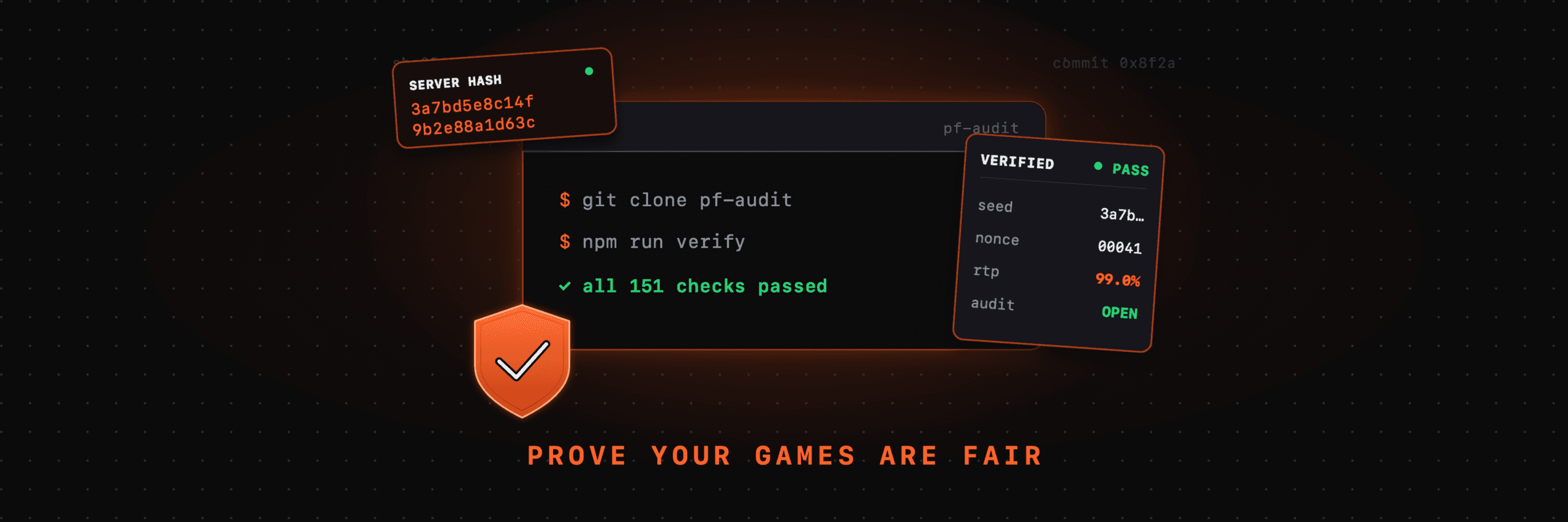
Every crypto casino calls its games provably fair. Far fewer can show, independently, that the claim holds and the games are genuinely fair and as advertised. A ProvablyFair.org certification closes that gap. It is the strongest statement of fairness available, and one a self-graded badge cannot make.
This explains what it is, why it matters to your players, and what earning one involves. It is written for operators, but there is nothing here we would tell a casino that we would not tell a player.
Trust is the product, not the games
Every casino offers the same dice, the same plinko, the same mines. The thing players are really choosing between is who they trust most. A certification is a concrete, defensible answer to that, and it does direct work on the factors that decide whether players stay.
- It keeps players through a bad run. Variance is the part of the model players handle worst, because gambling maths is deeply unintuitive. A losing streak feels like the house cheating, even when nothing is wrong. A certified badge on the game page gives that player somewhere to go: they click it, see the game is independently verified, and check their own bets against an independent verifier, not the casino’s own, instead of assuming they were cheated and bouncing. That moment is where a lot of churn is won or lost.
- The high-value players care most. Whales and crypto-native players are exactly the segment that scrutinises fairness, and exactly the segment worth retaining. When real money is on the line, “independently audited, here’s the proof” is a genuine reason to play your games over an identical one elsewhere.
- It gives support a straight answer. When a player opens a “this is rigged” ticket, support points to an independent, public audit the player can verify themselves, not a defensive explanation from the house. Disputes get shorter and cleaner.
- It is a real differentiator while it is still rare. Licensed third-party games are independently tested as a matter of course. A house building its own games, with a direct financial stake in the outcome and no outside check, is exactly the setup players have learned to be wary of. Almost no one offering in-house games can yet show independent, reproducible proof of fairness, so being early means the claim is distinctive rather than expected.
For an operator whose games are honest, none of this is a compliance cost. It is the strongest statement of fairness currently available, and one no self-issued badge can make.

Why certify if it’s already provably fair?
Because provably fair, on its own, still leaves the casino as the only party standing behind its own games.
A provably fair game lets a player check a result, but they are checking it against the casino’s own verifier, with the game and the verifier built by the same team. That is genuinely useful, but it is the house confirming the house. There have also been enough recent cases of games sold as provably fair that turned out to be faked, or not provably fair at all, that the words alone no longer carry the weight they once did.
An independent audit brings in a party that isn’t the casino. ProvablyFair.org verifies, with evidence anyone can check, that the casino’s live game does exactly what the casino says and advertises, across every game and every configuration.
It is fair to ask who actually re-runs it. The audits are technical, and most players never will. That is fine, because the point is not that everyone verifies, it is that anyone can. The people with the strongest reason to look — skeptical players, high-stakes players, security researchers, and service providers — can all clone the public repository and check every result for themselves. The barrier has never been lower: the whole audit reproduces with a single command, or can be pasted into an AI that walks through it in minutes. The trust does not rest on our word. It rests on proof that is sitting in the open for anyone who wants to break it.
What an audit proves
Every audit comes down to five questions about each game. Each one is shorthand for a whole series of individual checks, typically 15 to 30 chained together in sequence, all of which a game has to pass. The full methodology sets out exactly what sits behind them.
| The question | What it establishes |
|---|---|
| Can the casino change an outcome after the bet? | Every result is committed before play and cannot be altered, swapped, or re-rolled |
| Is the randomness real? | The randomness is genuine, the player’s own seed feeds into it, and no party can predict or steer the outcome |
| Does the game follow its own rules? | The live game matches its published specification exactly, in every configuration |
| Is the house edge honest? | The real return-to-player is what is claimed, confirmed across millions of rounds |
| Does fairness hold under non-standard conditions? | Edge cases, unusual inputs, and timing cannot be used to break the game’s guarantees |
The audit does not take any of these on assertion. Each is demonstrated in code, against real bets from the live game, and published so anyone can check it.
What a certification covers
A certification applies to a casino, but it is earned game by game, and every certified game is named.
- All in-house provably fair games are audited, not a selection. A certification is meant to tell a player something about the platform. It cannot do that if an operator audits only its strongest titles. If a game is built in-house and offered as provably fair, it is part of the engagement.
- Third-party licensed games sit outside the certification. Titles a casino licenses from an outside studio are not the casino’s own implementation, so they are not covered. The certification page is always explicit about which games have been audited, so a player never has to assume.
How an audit runs
Once scope is agreed, every game follows the same framework, applied independently to each game in scope.
- Initiated. Scope is agreed, and we reconstruct each game from its published specification: an independent rebuild, not copied from the casino’s code.
- Bet capture. A script records a large sample of real bets from each live game, typically several thousand per game. Every captured outcome becomes evidence the audit must reproduce.
- Parity testing. Every captured bet is recomputed against our independent rebuild and must match exactly. This is what proves the live game is genuinely running the fair maths, not just claiming to.
- RTP simulation. We run from millions to hundreds of millions of simulated rounds to establish each game’s true return-to-player at statistical scale.
- Integrity testing. Each game is probed against the framework to confirm it cannot be gamed, rigged, or manipulated, and that it behaves correctly under pressure.
- Certification. Each completed game audit is reviewed by multiple senior engineers who did not build it, then published in full as an open-source repository, alongside the certification page and verification tools.
One point matters for trust: the live bets are captured through ordinary, anonymous accounts, the same as any player’s. The audit measures the real game every player sees, not a special build.
Timeline: a typical casino engagement runs around 4 to 6 weeks from start to published certification. Simpler games move quickly; a structurally complex game takes longer. The largest variables are how fast questions are answered on the operator’s side, and how quickly anything that needs fixing is remediated.
What we need from the operator
The audit is designed to require as little as possible from your team. To run it, we ask for:
- Game specifications, rules, and payout tables for every game in scope.
- Direct links to the live games, so there is no ambiguity about which build is audited.
- A technical point of contact, in practice a shared channel with one of your engineers, so questions are resolved quickly.
- For pre-launch games, a development environment for the early build work, with live capture sequenced for once the game is available.
Read access to your code is welcome but not required. Every audit reviews the game’s logic against its specification, and rebuilds the game independently from that specification either way, so you do not need to hand over your codebase to be certified.
What a completed certification produces
- A certification page on ProvablyFair.org, naming each audited game.
- A full report portal: the individual audit for every game, a dashboard, and an executive summary.
- A public, open-source repository for every game. This is the core of it: the captured bet dataset, the simulation code, and the full verification suite. Anyone can clone it and reproduce every finding with a single command.
- A verification tool, hosted on our domain and built from the independently-audited code, not a copy of the casino’s own verifier, so any player can check a bet against the implementation the audit actually validated.
- A player support page, where a player reports a verification issue directly to us, not the casino.
- A certification badge for your site. You can also place a badge on each game, linking straight to that game’s audit, so a player on a bad run can click through from the game itself and see it is verified, without going looking.
The verifier is hosted by us, not the operator, and that independence is the point. A verification tool the casino controls can only ever show that the casino agrees with itself.

A verdict the casino cannot control
First, the reassuring part, because it is the common case. Almost everything an audit turns up is a minor implementation issue, a bug or a build error, which is shared with the operator, fixed, re-checked, and recorded in the report alongside its resolution. A genuine issue, found and fixed, does not stop a game being certified — and publishing it, rather than hiding it, is exactly what gives a player confidence the process is honest.
What sits underneath everything is a single commitment: every audit is published, whatever it finds. A pass is published. A failure is published. A casino does not get to commission an audit, see the result, then decide whether the world sees it.
This is the answer to the obvious question: a casino pays for the audit, so why should anyone trust the result? The same tension applies to financial auditors and testing labs, and the answer is not a promise, it is how the audit is built:
- The fee does not move with the result. We charge the same whether a game passes or fails, and our fee is not tied to player activity or losses. Compare that to an affiliate or sponsored reviewer, who earns a cut of what players lose and is paid more when the casino wins. Their incentive points one way. Ours points nowhere, so we have no reason to return a particular verdict.
- The whole audit is open-source and reproducible. A verdict that did not hold would be caught the first time anyone re-ran it.
- The result is binary. The game passes every check or it does not. There is no subjective judgement to lean on.
The only thing certification cannot accommodate is a game that isn’t actually fair and can’t be made fair, where the maths itself is built to disadvantage the player beyond what’s disclosed. That is the one thing certification exists to catch, and for an operator running honest games it is never in play. It is simply what makes the badge mean something: it cannot be earned by a game that doesn’t deserve it.
The operator always sees findings before publication, so there are no surprises. But seeing them first is not the same as controlling them.
Certify your casino
If you operate a crypto casino with in-house provably fair games and want to discuss certification, get in touch.
Get in touch